
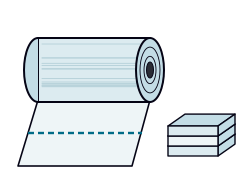
How a roll filter works
The media feeds from a supply spool at the top (or side), across the face of the filter section, onto a take-up spool. A timer or a pressure switch advances it a little at a time. When the supply spool runs out, the dirty roll comes off and a new roll goes on.
Roll filters are common in arenas, gyms, natatoriums, large make-up air units, older central air handlers and some industrial intakes, where changing hundreds of individual panels would take too long.
How to order the right roll
| What we need | Where to find it |
|---|---|
| Width | Roll label, or measure the media across the face |
| Length | Roll label, or ask us to match your unit |
| Media | Synthetic or fiberglass; check the old roll |
| Efficiency | Usually low to mid efficiency, often followed by a better final filter |
| Unit make and model | Nameplate on the roll filter section |
A photo of the roll label or the unit nameplate is usually enough.
Synthetic or fiberglass rolls
Both work. Synthetic media is durable and has been easier to get in 2026; fiberglass roll media has had long lead times this year. If your units take fiberglass, order further ahead or ask us about a synthetic equivalent.
A representative situation
A university arena and recreation buildings ran roll filters in several widths, and every reorder turned into a search for the right part number. We matched each width to the right roll and set up a stocking program for the large air handlers, so rolls are on hand before the change. See air filtration for colleges and universities.
How Filterful helps
We match every roll width to your units, stock rolls at our Johnson City or Nashville warehouse, and deliver on our own trucks. Roll media can also be cut to custom widths (custom and odd-size filters). We use filters manufactured in America.